





Tool Chest Size Guide: What Size Do You Need for a Home Garage?
How to Choose the Right Tool Chest Size for Your Tools and Garage
The right tool chest size is not the one with the most drawers or the widest cabinet. It is the one that fits the tools you actually store and still works in the space your garage can give it.
That means making two decisions at the same time: tool storage fit and garage space fit. First, check what your tools require inside the chest. Then make sure the chest itself can sit, open, and move in your garage without blocking a vehicle, walkway, workbench, door, or other storage.
This guide walks through that process step by step so you can rule out chests that are too small, unnecessarily large, or awkward to use once they are in place.
Table of Contents
- Start With Your Tools, Not the Tool Chest
- Inventory the Tools You Actually Need to Store
- Turn Your Tool Inventory Into Drawer Requirements
- Measure the Maximum Tool Chest Size Your Garage Can Handle
- Check the Space the Chest Needs When You Use It
- Allow for Future Tools Without Oversizing the Chest
- Make the Final Tool Chest Size Decision
Start With Your Tools, Not the Tool Chest
A common mistake is to begin by comparing cabinet widths, drawer counts, or sale prices. Those details matter only after you know what must fit inside. A 24-inch chest can work well for one homeowner and be unusable for another because their tools have different lengths, heights, and storage needs.
Think of tool chest sizing as a two-part filter. The first filter is storage fit: can the drawers and compartments hold your actual tools without forcing long items in diagonally or stacking everything into one deep drawer? The second filter is garage fit: can the cabinet occupy the available floor area while leaving enough room to open drawers and use the garage normally?
Do not treat drawer count as a substitute for usable capacity. Two chests with the same number of drawers can have very different drawer widths, depths, heights, and layouts. Likewise, an exterior cabinet width does not tell you the usable internal drawer width.
Inventory the Tools You Actually Need to Store
List the tools that will actually live in the chest. Leave out items that already have a better home on a wall rack, shelf, pegboard, or separate case. This keeps you from buying extra cabinet space for tools that do not need drawer storage.
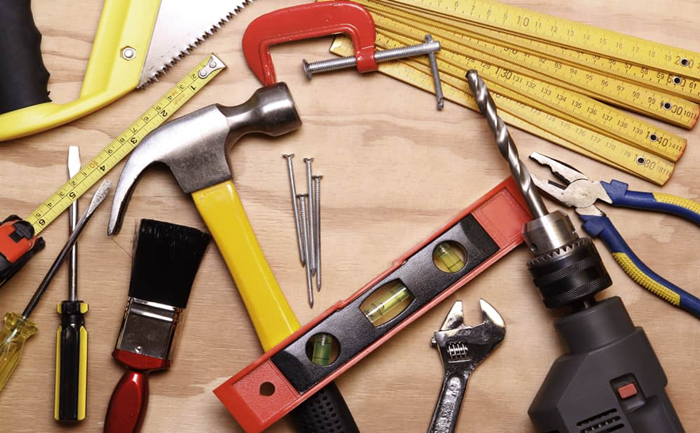
Group the remaining tools by how they need to be stored rather than simply counting them. Useful groups include hand tools, sockets and ratchets, long-handled tools, cordless power tools, measuring tools, and small parts or accessories.
Next, identify the pieces that create the hardest fit. Measure the longest torque wrench or breaker bar, the tallest cordless tool you expect to place in a drawer, and any bulky case or battery that needs more vertical space. These few items often determine the minimum drawer dimensions more than the total number of screwdrivers or sockets.
Also note how you prefer to arrange tools. A socket set kept in its original tray may need more usable drawer width than the same sockets stored on compact rails. A cordless drill stored upright needs more drawer height than one stored on its side. The article's goal is not to force one organization method, but to make sure your preferred method fits.
Turn Your Tool Inventory Into Drawer Requirements
Once you know what has to go inside, translate those tools into drawer requirements. The three dimensions that matter are usable width, usable front-to-back depth, and usable height. Compare these with the tools in the position you plan to store them.
Width matters for long rows of wrenches, socket trays, and side-by-side hand tools. Depth matters when a long tool needs to lie front to back. Height matters for cordless tools, chargers, cases, and bulky accessories. A good configuration often mixes shallow drawers for hand tools with a few deeper spaces for larger equipment.
Product pages do not always publish every internal drawer measurement. If an exact usable dimension is missing, do not estimate it from the exterior cabinet size. Check the manufacturer's product information, manual, or seller support for the exact model before assuming a long or bulky tool will fit.
| Tool collection / storage need | What to measure or check | Likely storage requirement | Sizing implication |
|---|---|---|---|
| Basic hand tools | Longest tool, quantity, preferred layout | Mostly shallow or medium drawers | A compact chest may be enough if usable drawer dimensions fit the tools |
| Sockets, ratchets, and wrench sets | Tray or organizer width, longest wrench, set layout | Wide shallow-to-medium drawers | Prioritize usable drawer width and layout, not drawer count alone |
| Torque wrenches and long-handled tools | Overall tool length and handle clearance | Long or full-width drawers | Confirm actual internal drawer dimensions before purchase |
| Cordless drills and power tools | Tool height, width, battery size, case size | A mix of taller drawers or lower cabinet space | More vertical storage may matter more than adding more shallow drawers |
| Small parts and accessories | Organizer-bin dimensions and quantity | Shallow drawers with bins or dividers | Do not size the entire chest around small parts alone |
| Bulky equipment or storage cases | Case dimensions and stored weight | Deep drawers or cabinet-style storage | Check both usable dimensions and the model's published load limits |
Use the matrix as a filter rather than a universal size chart. A compact chest may be sufficient for a small hand-tool collection, but only if its usable drawers fit the longest tools and the total layout. Likewise, a larger chest is not automatically better if most of its extra volume is in drawer sizes you do not need.
Measure the Maximum Tool Chest Size Your Garage Can Handle
After you establish the storage configuration you need, measure the space where the chest will live. Do this before comparing specific models. The available area should reflect real obstructions such as shelving, pipes, outlets, door tracks, parked vehicles, and the edge of a workbench.
Record the maximum width, depth, and height that the cabinet can occupy. For a rolling chest, also consider handles, side trays, casters, or other parts that may add to the working footprint. Published dimensions vary by model, so compare the measurements of each shortlisted chest with your own limits.
Do not stop at the static footprint. A cabinet that fits against the wall can still be a poor fit if the drawers cannot open far enough or if you have nowhere to stand while using it.
Garage Fit Measurement Checklist
| What to measure | What to check | Why it matters |
|---|---|---|
| Available width | Clear horizontal space between walls, shelving, cabinets, or other obstacles | Sets the maximum cabinet width |
| Available depth | Distance from the wall to the nearest vehicle, work area, or obstruction | Prevents the chest from taking over parking or walking space |
| Available height | Floor-to-shelf, window, cabinet, or other overhead restriction | Checks whether a tall chest or upper cabinet will fit |
| Drawer-opening space | Space in front of the chest needed for one drawer to extend fully | Confirms the chest is usable, not merely able to sit in place |
| Vehicle-door clearance | Space needed to enter and exit a parked vehicle | Prevents the chest from interfering with everyday garage use |
| Walkway / work position | Room to stand, walk, and reach tools comfortably | Keeps the storage zone functional during actual work |
| Movement path, if mobile | Door openings, thresholds, tight turns, and floor condition | Matters only if you plan to roll the chest between locations |
| Fixed obstacles | Outlets, pipes, doors, columns, shelving, and other permanent features | Avoids access or placement conflicts |
Check the Space the Chest Needs When You Use It
A tool chest has two footprints: the space it occupies when closed and the space it needs while you are using it. The second is easy to overlook.
For drawer-opening clearance, check one drawer at a time and follow the manufacturer's instructions for the model. Do not open several loaded drawers at once just to measure reach. If the manufacturer provides drawer-extension or open-depth information, use that specification; otherwise, verify clearance carefully with the actual model or seller information.
If you plan to move a rolling chest between storage and a work area, measure the route as well as the final parking spot. Check door widths, thresholds, floor transitions, and tight turns. If the chest will remain stationary, movement clearance should not become an unnecessary reason to buy a smaller cabinet.
Finally, test the garage as a normal space, not an empty floor plan. Can a car door still open? Can someone walk past the chest? Can you stand in front of an open drawer without being squeezed against a vehicle or workbench? Those answers can eliminate a model that looked fine on a dimensions page.
Allow for Future Tools Without Oversizing the Chest
A chest that is almost full on day one leaves little room for a growing tool collection, but buying the largest cabinet that fits the wall can waste valuable garage space. Plan for growth based on tools you are reasonably likely to add, not on a vague idea that you may need more storage someday.
If you already know you plan to buy a bulky item, such as a larger cordless tool, specialty automotive kit, or long torque wrench, use the expected tool or case dimensions when evaluating the chest now. This is more useful than applying a fixed percentage of 'extra capacity' that may not match the shape of future tools.
If future purchases are less specific, favor a flexible drawer mix and some uncommitted usable space rather than a dramatic jump in cabinet size. The goal is to avoid replacing the chest too soon while preserving the room you need for vehicles, walkways, and other garage functions.
Make the Final Tool Chest Size Decision
At this point, you should have two sets of limits: the minimum usable storage your tools require and the maximum footprint your garage can accept. A tool chest belongs on your shortlist only if it passes both.
Use the following decision sequence for each model. If a model fails an early step, remove it rather than trying to justify the purchase with extra features.
-
Do the usable drawers fit your longest, tallest, and bulkiest stored tools?
No: reject the model or choose a different drawer configuration. Yes: continue. -
Does the drawer mix suit how your collection is actually organized?
No: reject it even if the overall cabinet is large enough. Yes: continue. -
Does the closed cabinet fit within your measured garage width, depth, and height limits?
No: reject or choose a different placement. Yes: continue. -
Can one drawer open fully without blocking a vehicle, workbench, door, or required walkway?
No: reject, reposition, or verify a shallower model. Yes: continue. -
If the chest will move, can it travel safely through the intended route?
No: choose a stationary plan or a smaller/mobile model. Yes: continue. -
Does the configuration leave useful room for realistic future tools without taking unnecessary garage space?
No: compare the next suitable configuration. Yes: shortlist the model. -
Are the exact model's published load limits and dimensions suitable for the tools you plan to store?
No or unknown: verify before buying. Yes: the model has passed the fit check.
For example, imagine your available garage area is 54 inches wide and 30 inches deep. Two rolling chests may both fit that closed footprint. The smaller one may leave more walkway room, while the wider model may offer the drawer geometry needed for a long torque wrench and a taller cordless-tool drawer. The correct choice is not simply the larger chest. Compare the manufacturer-listed usable drawer dimensions, test open-drawer clearance, and then choose the smallest configuration that meets your actual storage and growth needs.
Once you know your required dimensions and drawer configuration, you can compare options in GARVEE's Tool Chests & Cabinets category instead of browsing by drawer count alone. Verify the exact model specifications before purchase because drawer dimensions, load limits, handles, caster setups, and cabinet layouts can vary.
Choosing the right tool chest size comes down to a simple rule: measure the tools first, measure the garage second, and buy only after the same model passes both tests. That approach gives you enough storage to work comfortably without sacrificing more garage space than you need.
More to read:
Tool Organizer vs Tool Chest: Which One Is Better for Your Garage Workshop